Myopia Progression and its Consequences
Myopia progression varies from child to child; however, children with early-onset myopia are more likely to progress to high myopia (≤-6.00 D)*, increasing their lifetime risk of severe ocular disease.1-3
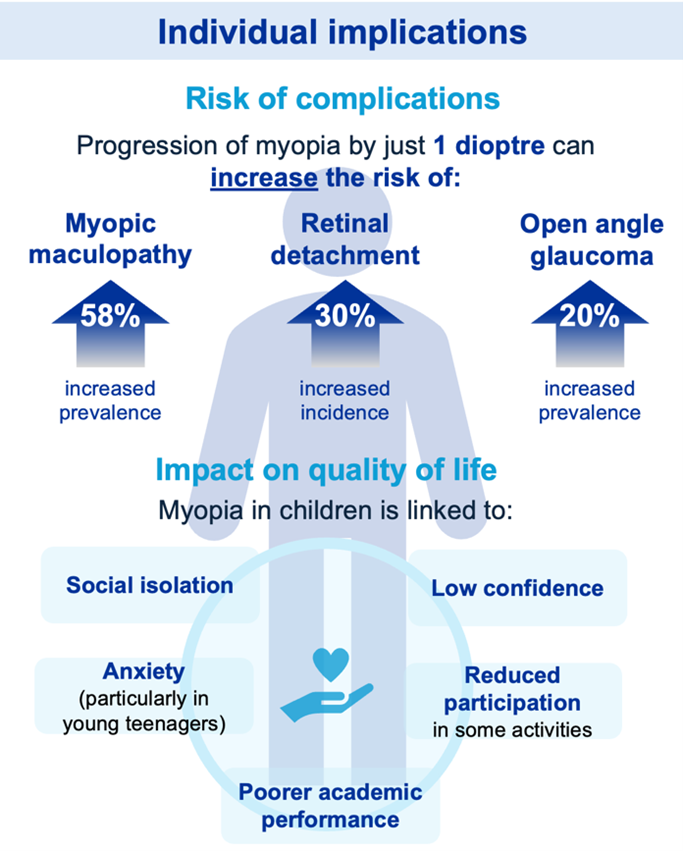
Each 1 dioptre increase in myopia substantially raises the likelihood of developing sight-threatening complications and can impact children’s quality of life.4-8
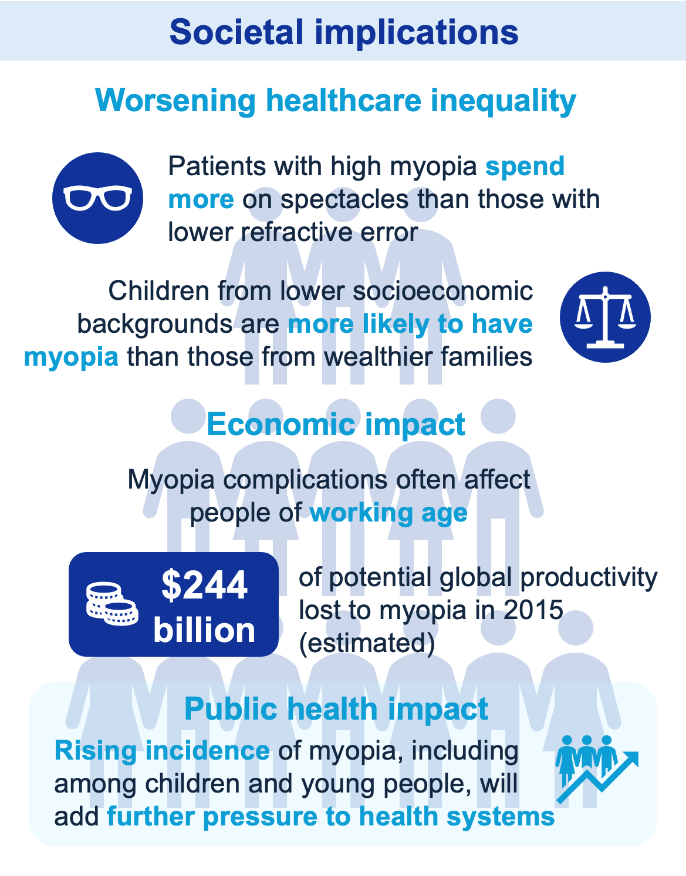
Beyond the impact on the individual, progressive myopia has implications for broader society as well.5,7,9-12
The potential benefits of controlling progressive myopia in children include enhanced self-confidence, reduced anxiety, limited dependency on glasses, and improved psychosocial wellbeing, further highlighting the need to act early against a disease that can irreversibly damage children’s eye health and overall wellbeing.4-6,11,13,14
Early detection and timely intervention remain essential to slow progression, preserve vision, and reduce long-term impact on both the individual and public health systems.10,11
Footnotes
*Compared with myopia developed at a later age.15
References
Chua SYL, et al. Ophthalmic Physiol Opt. 2016;36:388-394.
Verkicharla PK, et al. PLoS One. 2020;15:e0241759.
Gifford KL, et al. Invest Ophthalmol Vis Sci. 2019;60:M184-M203.
Bullimore MA, et al. Ophthalmology. 2021;128:1561-1579.
Rose K, et al. Br J Ophthalmol. 2000;84:1031-1034.
Lazarczyk JB, et al. BMC Ophthalmol. 2016;16:201.
Congdon N, et al. Community Eye Health. 2019;32:7-8.
Dudovitz RN, et al. Matern Child Health J. 2015;20(5):974-983.
Philipp D, et al. BMC Public Health. 2022;22:2058.
Holden BA, et al. Ophthalmology. 2016;123:1036-1042.
Dahlmann-Noor AH, et al. Ophthalmic Physiol Opt. 2024;44(7):1368-1391.
Modjtahedi BS, et al. Ophthalmology. 2021;128:818-826.
Flitcroft DI, et al. Invest Ophthalmol Vis Sci. 2019;60:M20-M30.
Németh J, et al. Eur J Ophthalmol. 2021;31:853-883.
Verkicharla PK, et al. Ophthalmic Physiol Opt. 2015;35:465-475.