Understanding Progressive Myopia
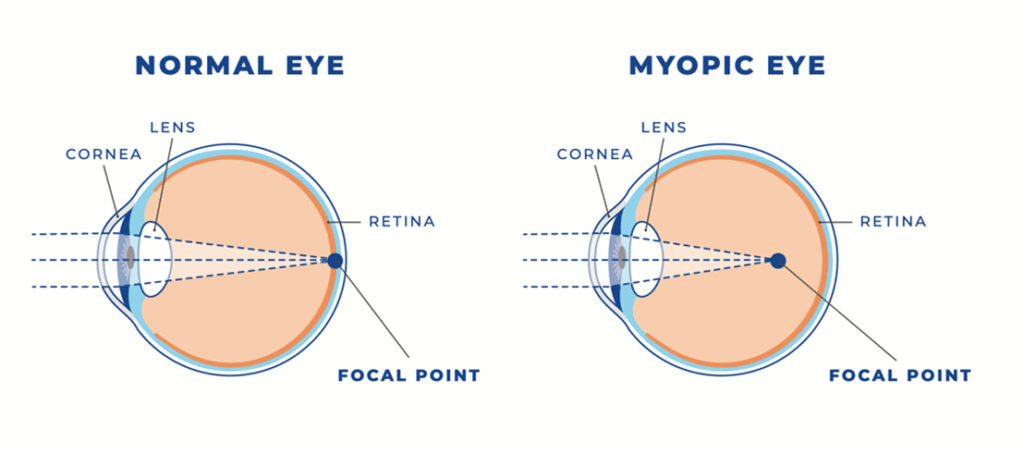
Progressive myopia is a refractive disorder that worsens over time and can lead to irreversible vision loss.1,2 It occurs when the eye’s optical power and axial length are not aligned, causing light to focus in front of the retina rather than directly on it, resulting in blurred distance vision.3
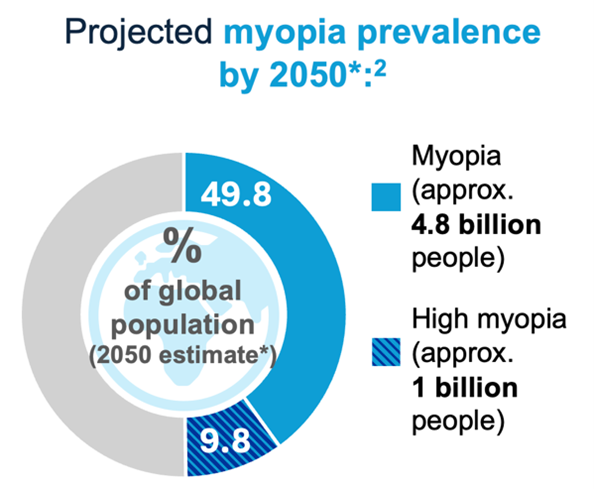
By 2050, it is estimated that myopia will affect approximately 50% of the global population and become a leading cause of blindness worldwide.4 Around one third of children and adolescents are affected by myopia and the global incidence could exceed 740 million cases by 2050.5
In the UK and Ireland alone, myopia associated pathology is projected to affect more than 2 million people by 2051-2.6 Approximately 4 million people over 40 are expected to have high myopia just in the UK and Ireland by the 2050s, however, no clinical interventions for progressive myopia are currently publicly funded.6,7
These estimates highlight a major emerging public health issue. The rise of myopia is likely linked, in part, to lifestyle and environmental shifts in an increasingly digitalised world.3
Progressive myopia typically develops in childhood, often around the age of six, but onset can occur as early as three years old.8 Children who develop myopia at a younger age are more likely to experience rapid progression, which increases their lifetime risk of developing high myopia, and can increase the risk of associated comorbidities.9-11
Early awareness and detection are therefore critical to protecting long-term ocular health.3
Footnotes
*Estimate from systematic review and meta-analysis of 145 studies with 2.1 million participants.4
References
Flitcroft DI, et al. Invest Ophthalmol Vis Sci. 2019;60:M20-M30.
Németh J, et al. Eur J Ophthalmol. 2021;31:853-883.
Martínez-Albert N, et al. J Clin Med. 2023;12:6062.
Holden BA, et al. Ophthalmology. 2016;123:1036-1042.
Liang J, et al. Br J Ophthalmol. 2025;109:362-371.
Kynman-Sprinks D, et al. BMJ Open Ophth. 2025;10:Poster 125959.
Dahlmann-Noor AH, et al. Ophthalmic Physiol Opt. 2024;44(7):1368-1391.